

Whole house water filtration system demand is skyrocketing as homeowners respond to headline-making water quality scares. If you’re researching whole house water filtration system installation to solve real contaminant risks—like lead, PFAS, or stubborn hard water—this playbook lays out exactly how to evaluate, budget for, and realistically troubleshoot installation challenges before you hire a contractor.
Key Takeaways
- Over 1 in 3 U.S. homes now have a whole house water filtration system—growth is driven by stricter regulations, PFAS and lead concerns, and aging water infrastructure (source).
- Professional installation, pressure testing, and whole-system certification are essential—most user complaints stem from overlooked plumbing issues and recurring cartridge costs.
- Before calling contractors, test your water, review recurring maintenance costs, and demand proof of true NSF/ANSI certification for the assembled system, not just its components.
- Quick Market Snapshot — Adoption, Size and Growth
- Why Choose a Whole-Home (Point-of-Entry) Filter vs. Point-of-Use Options
- What Contaminants Whole-House Systems Can Target — and How Effective They Are
- Common Negative Reviews and Installation Complaints — The Real User Pain Points
- Cost Breakdown for 2024 Purchases and Installation
- Installation Requirements & Complexity by Technology and Brand
- Which Home Plumbing Layouts Cause Installation Headaches — and How to Prepare
- Top 3 Crucial Considerations Competitor Articles Usually Miss
- Practical Next Steps — A 7-point Decision & Installation Checklist
- FAQ
Quick Market Snapshot — Adoption, Size and Near-Term Growth
Whole house water filtration system adoption has surged—about one third of U.S. homes and a quarter of global households now use whole-home (point-of-entry or POE) filtration. This isn’t just a niche trend: From a $48 billion global market in 2025, sales are projected to reach $50.8 billion in 2026 with a robust 7% compound annual growth rate (CAGR). In the U.S., the market is expanding at about 6.5% CAGR through 2036 (source, source).
This fast adoption is driven by:
- PFAS and lead scares in municipal water (following events like Flint and Newark).
- Hard water problems—over 85% of U.S. homes have hard water, impacting appliances (source).
- Stricter regulatory enforcement under SDWA and EPA monitoring.
Why Choose a Whole-Home (Point-of-Entry) Filter vs. Point-of-Use Options
Most people start off with point-of-use (POU) filters—such as a pitcher or faucet-mounted system—because they target drinking water at a single tap. Whole home water filter installation, by contrast, puts a system on your main water line so it treats every drop entering your house before it hits any faucet, shower, or appliance.
- Comprehensive protection: POE filtration targets not only drinking water but also bathing, laundry, and every appliance.
- Prevents scaling and staining: Key for hard water regions and for extending the life of appliances and plumbing.
- Bathing and inhalation exposure: Many contaminants like chlorine and volatile organics are absorbed or inhaled in the shower, not just ingested.
- Best when: Your water test reveals broad issues (lead, PFAS, iron, sediment, or hard water) or if you want consistent quality across all sinks, baths, and appliances.
POU-only is often insufficient. According to market research, the trend is shifting toward POE solutions as awareness grows about contaminants entering home plumbing prior to reaching fixtures.
What Contaminants Whole-House Systems Can Target — and How Effective They Are
An advanced whole house water filtration system can remove a wide spectrum of contaminants. System performance hinges on the specific technology used and whether the assembled filter is certified for your concerns by trusted third parties (NSF/ANSI).
- Typical targets (POE systems): Lead, PFAS (PFOA, PFOS), mercury, chromium-6, chlorine, iron, manganese, arsenic, uranium, nitrate, sulfur, sediment, hardness minerals (calcium/magnesium), and microbial pathogens (source).
- Whole home systems can also mix tech—for example, pairing carbon block filters with UV disinfection add-ons for pathogen reduction or with softener systems for scale control.
Why certification matters: Only NSF/ANSI-certified POE systems guarantee contaminant reduction meets lab-tested standards for safety and effectiveness (source).
Keep in mind: Over 45% of U.S. tap water samples now detect PFAS, and over 85% of U.S. homes struggle with hard water. A correct match between test data and filter design is critical.
Common Negative Reviews and Installation Complaints — The Real User Pain Points
Many homeowners expect “set it and forget it” results, but the real-world experiences differ. Here are the pain points collected from verified buyers and service calls:
- Pressure drops: “My shower feels weaker after the filter was put in.” Most common when cartridges clog or pipe sizing is too small for household demand.
- Cartridge/bulk filter replacement costs: “No one told me I’d pay so much just to keep this thing working.” Most POE systems need new replacement filters every 6 to 12 months—costs are often higher than expected, especially for multi-stage or specialty filters.
- Compatibility and leakage issues: Installs in homes with old galvanized pipes or cramped spaces often require more labor and are more likely to develop leaks around seals or fittings.
- Need for professional help: “DIY install looked easy on YouTube, but connecting to my plumbing made me call the pros.” Retrofitting older homes is frequently complicated and almost always requires a skilled plumber.
One homeowner put it simply: “It fixed my water, but I have to budget both for quarterly filter packs and for the drop in flow to the upstairs shower.”
Pressure, flow, and maintenance are the top sources of frustration. Planning before purchase—and verifying with your installer—lowers the chances of surprise costs or performance disappointments.
Cost Breakdown for 2024 Purchases and Installation (System Price, Labor, Hidden and Recurring)
The total cost of a whole home water filter installation varies by home layout, local labor rates, filter technology (carbon, RO, UV, softener), and added components. There is no single U.S. “average” due to regional differences, but here’s what every homeowner must budget for:
- System and major filters: $900–$3,500+ (carbon systems), $2,000–$8,000+ (multi-stage/RO/UV combos), with higher costs for well water setups.
- Professional installation labor: $500–$2,000, more for difficult retrofits or layout challenges. (Always ask for a site visit and written quote.)
- Water test (pre-purchase): $80–$300 for full lab analysis (recommended for wells and quality-conscious buyers).
- Permits/inspections: $50–$400, where local codes require.
- Cartridge/replacement filters (recurring): $120–$700 per year, depending on system and water quality. Most filters last 6–12 months.
(Research from real buyer reviews confirms: recurring filter costs are a major ongoing expense source.) - Service contracts (optional): $150–$400 per year if you prefer annual pro checkups.
What vendors often omit: The additional cost and downtime if retrofits to pipes/plumbing, bypass valves, or shutoff valves are needed. Always ask if your home’s entry layout has specific complications. For more cost discipline on major home upgrades, see our ADU garage conversion cost guide and crawl space encapsulation cost coverage.
Installation Requirements & Complexity by Technology and Brand
Not all whole house filters are the same. Installation difficulty varies by technology and even by brand, affecting both cost and risk of problems:
- Carbon block/activated carbon POE systems: Most common, relatively straightforward for a pro. Placement near entry, requires adequate space and a sturdy wall or floor install.
- Reverse osmosis (RO) and ultrafiltration (UF) POE: Less common as whole-home (primarily used at point-of-use). More complex; requires drain connections and usually pressure boosts.
- UV disinfection add-ons: Often paired with carbon or softener for well water. Needs dedicated electrical outlet, proper mounting, and flow/pressure checks.
- Brand/design variables: Inlet/outlet pipe size, mounting method, inclusion of bypass valves—all impact installation. Cheap or “universal fit” units often require more retrofitting on older plumbing. Always request sizing and pressure information specific to your home.
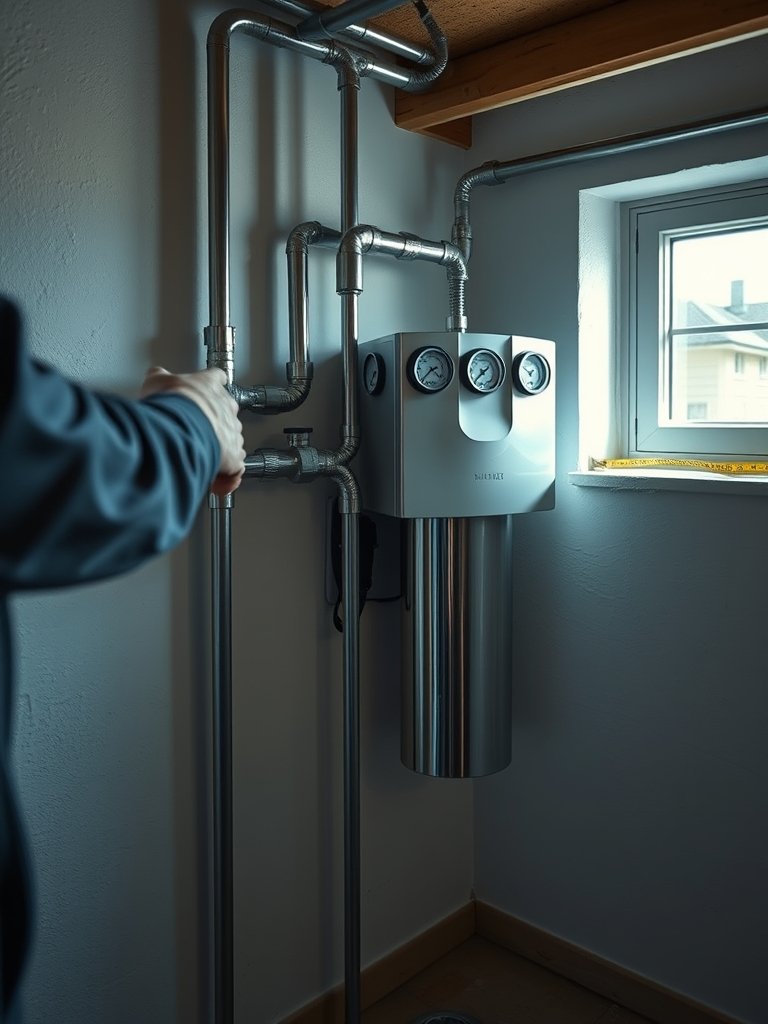
Any installation becomes costlier and more prone to leaks or failures if old galvanized piping, cramped basements, or nonstandard water entry points exist. For complex retrofits and upgrades, internal guides like our home EV charger installation playbook and heat pump water heater rebate guide provide tested approaches for contractor vetting and assessment.
Which Home Plumbing Layouts Cause the Most Installation Headaches — and How to Prepare
Not all homes are created equal from a plumbing perspective. The challenges below routinely increase both installation complexity and cost:
- Basements with limited access, crawlspaces, or no wall space near entry
- Homes with old galvanized or mixed-metal water pipes
- Well systems with sump/pressure tanks and multiple feed lines
- Multiple water inlets—common in larger or multi-family homes
- Low pressure or low-flow fixtures already installed
For wells, an in-depth water analysis should include iron, manganese, pH, hardness, total dissolved solids—this guides both filter choice and correct sizing (source).
Homeowner’s Prep Checklist:
- Schedule an independent lab water test (not just a DIY strip).
- Take clear photos of the water main entry, valve locations, and pressure tanks (for wells).
- Measure pipe sizes and note material (copper, PVC, galvanized, PEX, etc.).
- Document whether you’re on city water or a private well (affects filter choice and cost).
- Plan for a main water shutoff and ask about per-hour rates if the job goes long.
Top 3 Crucial Considerations Competitor Articles Usually Miss
- Certification Must Cover the Whole System—Not Just Components
Many brands market “certified” filters, but true NSF/ANSI testing applies to the entire assembled unit (including housing, O-rings, connections) under real-world flow rates. Always demand lab reports for the finished system—not just documentation for the carbon media or UV bulb.
Pro insight: Experts urge buyers to verify whole-system certification, not settle for piecemeal claims. - True Lifecycle Cost Analysis
Budget for more than the sticker price: installation, expected cartridge/UV bulb service intervals, filter disposal, and energy use (for UV/RO systems) are all part of the true cost of ownership. - Compatibility and Pre-Purchase Pressure + Flow Testing
Before committing, confirm that the system can deliver enough flow for your household’s peak shower/laundry/dishwasher use. Include a bypass valve for maintenance, and consider booster pumps if your home has long plumbing runs or low city pressure.
For a comparison of similar planning pitfalls in modern home electrification, check our whole-home generator installation guide and solar panel installation cost explainer.
| System Type | Installation Complexity | Maintenance Frequency | Realistic Drawbacks |
|---|---|---|---|
| Carbon Block POE | Low–Moderate | 6–12 Months | Pressure drop if undersized or not serviced |
| POE RO/Ultrafiltration | High | 6–12 Months | Flow rates; may require pumps |
| UV System (Add-on) | Moderate | Lamp annually | Needs electricity; can’t address chemicals |
| Softener + Filter | Moderate | Salt/monthly; filter/annual | Salt handling; space needed |

Practical Next Steps — A 7-Point Decision & Installation Checklist for Homeowners
- Get a full certified water test from a lab (not just a DIY kit).
- Set your contaminant removal priorities based on real risks (PFAS, lead, iron, hardness, etc.).
- Review and request NSF/ANSI certification documentation for the assembled system.
- Collect at least two or three written contractor quotes—be sure they include any needed plumbing retrofits, bypass valves, and mounting.
- Budget for recurring filter/bulb maintenance (typically every 6–12 months; ask about bulk order discounts or service packages).
- Verify parts and service availability locally—avoid uncommon brands or “direct ship only” systems with no local support.
- Schedule a pre-purchase site survey with your chosen contractor to confirm layout, pressure, and bypass valve needs.
Given the widespread detection of PFAS and other contaminants, and the reality that most installs require some plumbing retrofit, skipping lab testing or contractor walkthroughs is a recipe for trouble. For maximum confidence, review related upgrade checklists—like our soundproof office wall installation guide or minimalist kitchen remodel strategies—to model your decision and vetting process.
FAQ
How long do whole house water filters really last before needing replacement?
Most main cartridges or filter sets last 6 to 12 months, depending on your water quality and household consumption. Multi-stage and specialty filters (like those for iron or PFAS) may need changing more often if your water carries a high contaminant load. Always monitor flow; a drop usually signals replacement time.
Does a whole house water filtration system lower my water pressure?
If properly sized by a professional, the pressure drop is minimal—often barely noticeable. However, if the installer used a basic filter undersized for your flow rate, or if cartridges aren’t changed when clogged, you’ll feel weaker showers and longer fill times. Always insist on pressure/flow tests before and after install.
Can I install a whole house water filter system myself?
Basic systems can be installed DIY if you are confident with cutting and plumbing main pipes. However, most homeowners should budget for professional plumbing—especially in homes with old, mixed-metal pipes, wells, or limited access. DIY errors are a common cause of leaks, pressure loss, or filter failure.
What’s the difference between whole house filtration and a water softener?
Whole-house water filters remove a wide range of contaminants (lead, PFAS, chlorine, sediment, etc.), while softeners primarily remove calcium and magnesium minerals (hardness) that cause scale. Many systems combine both for comprehensive protection—especially in regions with very hard water.
What certifications should I look for?
Insist on NSF/ANSI certification for the assembled system (not just individual components), verified by independent third-party labs. This is your guarantee that the unit meets specific contaminant removal claims and is safe for household use.
Conclusion
Investing in a whole house water filtration system is a big step—but one that delivers real peace of mind if you approach it with hard data, cost realism, and hands-on planning. From testing your water to vetting contractors and demanding certification, clarity up front prevents frustration down the line. Ready to upgrade your home’s water quality for the long haul? Get your water tested, gather quotes, and build your checklist before your first call with a pro.